How to Correctly Size a Sewage Lifting Tank for Optimal Performance
Getting a sewage lifting tank sized right is one of those decisions that quietly determines whether your wastewater system runs smoothly or fights you every step of the way. I’ve seen undersized tanks cook pumps with endless starts and stops, and oversized ones stew into odor complaints and corrosion. In this overview, we pull together the essentials—what goes wrong when sizing misses the mark, the terminology that keeps everyone aligned, the factors and calculations that matter, and the practical installation, compliance, and maintenance choices—so engineers, facility managers, and technical teams can design systems that are both robust and efficient.
Understanding the Critical Role of Proper Sewage Lifting Tank Sizing
Getting the size right is foundational to reliable wastewater infrastructure. Tanks that are either too small or too large undermine system integrity and day-to-day efficiency. Precision at this first step avoids a chain of downstream problems.
1. The Consequences of Undersized or Oversized Systems
Undersized tanks trigger frequent pump cycling, accelerating component wear, shortening equipment life, and increasing energy use. Pumps are pushed outside their optimal efficiency band, elevating the risk of motor overheating and premature failure. During peak flows, an undersized tank can overflow, creating environmental impacts and regulatory issues.
Oversized tanks bring a different set of headaches. Extended retention encourages anaerobic decomposition, generating hydrogen sulfide and other gases that cause odors and corrode tank internals and electrical equipment. You also pay more upfront and take more space than necessary. Longer holding times increase solids deposition, driving up cleaning frequency and cost. Either extreme translates into financial strain and operational disruption.
2. Key Terminology and Components of a Sewage Lifting System
A shared technical vocabulary makes sizing decisions far more accurate. Here are the core elements:
- Sewage Lifting Tank (or Sump): A watertight chamber that buffers incoming wastewater before it’s pumped to a higher elevation or treatment point.
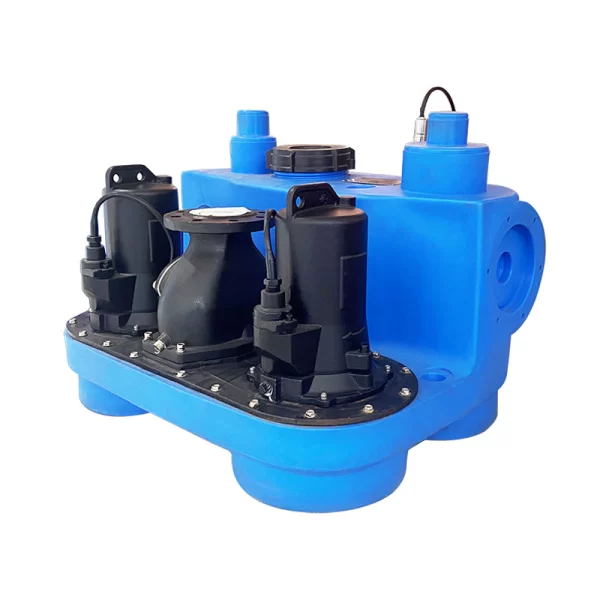
- Pumps: Typically submersible sewage pumps capable of handling solids and corrosive media; their selection is central to performance.
- Float Switches: Level sensors that start and stop pumps at predefined high and low set points.
- Control Panel: Coordinates pumps and level devices; commonly includes alarms for high level, pump faults, and power loss.
- Inlet and Outlet Pipes: The inlet delivers wastewater to the tank; the outlet carries it away. Pipe sizes influence hydraulics.
- Check Valves: Installed on discharge lines to prevent backflow when pumps stop.
- Gate Valves (or Isolation Valves): Allow maintenance on pumps without draining the full system.
- Working Volume: The volume between pump “on” and “off” levels, which sets run time per cycle.
- Sump Volume: Total liquid capacity from the inlet invert to the tank bottom.
- Retention Time: The average time wastewater stays in the tank, directly affecting septicity and odor potential.
Essential Factors Influencing Sewage Lifting Tank Capacity
Several factors directly set the required capacity. Skipping any of them can create avoidable issues. We look at each carefully to build resilient systems.
1. Analyzing Inflow Rates and Peak Demands
Sizing starts with inflow—both average and peak. Average flows shape typical operating load, while peaks define the no-overflow limit. Peaks often align with morning/evening usage or storm events in combined systems.
We base inflow on historical data, water consumption records, or fixture unit counts for new projects. In commercial/industrial settings, process wastewater rates are key. Future growth and usage shifts should be included. Underestimating peaks risks overflow and stress; overestimating inflates cost and reduces efficiency.
2. Determining Retention Time Requirements for Efficient Operation
Retention time is how long wastewater stays in the tank before discharge. Managing it prevents septicity—anaerobic breakdown that causes odors and corrosive gases.
For typical domestic wastewater, 15 to 30 minutes between pump cycles is a common target. Longer may be fine for dilute flows or frequent cycling, but it must be balanced against motor protection from excessive starts and stops.
3. Considering Solids Handling and Sump Volume
Real sewage carries solids—rags, grit, organics—and the design must move them through. The volume below the pump “off” level matters: minimize this “dead volume” to limit settling and anaerobic pockets, but keep enough to maintain pump submergence.
We favor sloped or conical bottoms that draw solids toward the intake. Choosing grinder or chopper pumps where appropriate helps. The sump design should prevent short-cycling yet consistently evacuate solids.
4. Accounting for Inflow and Outflow Pipe Diameters
Pipe sizes shape hydraulics and, by extension, tank performance. The inlet must pass peak flows without surcharging upstream sewers; too small and it backs up.
On the discharge side, pipe diameter and pump head/flow set velocity. Aim high enough to keep solids moving, but not so high that friction losses or water hammer become problems. Correct sizing lowers energy use and boosts reliability. Also consider how multiple pumps and their discharge lines combine in the manifold.
Step-by-Step Calculation Methods for Accurate Tank Sizing
A disciplined approach—sound theory plus practical judgment—delivers the right tank size and service life. Here’s the method we use.
1. Calculating Effective Volume and Working Volume
Start by defining effective and working volumes. Effective volume spans from the inlet invert to the pump “off” level; working volume is the gap between “on” and “off.”
- Determine Average Inflow Rate (Qavg): In m³/h or L/s.
- Determine Peak Inflow Rate (Qpeak): Captures maximum demand and storm effects.
- Calculate Minimum Working Volume (Vw_min): Ensure a pump run time (Tr) that avoids overheating—commonly 1 to 2 minutes per cycle.
- Vw_min = Qavg × Tr
- Calculate Maximum Working Volume (Vw_max): Cap retention to limit septicity; often tied to a 30-minute target.
- Vw_max = Qavg × Tretention (where Tretention is the desired maximum retention time, e.g., 30 minutes).
- Determine Optimal Working Volume: Choose a value between Vw_min and Vw_max to balance motor protection and odor control.
- Calculate Total Sump Volume: Add working volume, dead volume below “off,” and any safety freeboard above “on.”
2. Selecting the Right Pump Based on Flow and Head Requirements
Pump selection and tank sizing go hand-in-hand.
- Determine Required Flow Rate (Qpump): Often equals Qpeak, adjusted for number of pumps and redundancy.
- Calculate Total Dynamic Head (TDH): Sum static lift, friction losses, and required discharge residual pressure.
- Static Head: From minimum sump level to the highest discharge point.
- Friction Losses: Based on diameter, length, material, and flow (e.g., Hazen-Williams or Darcy-Weisbach).
- Consult Pump Performance Curves: Match Qpump and TDH to manufacturer curves to hit efficient operating zones.
- Consider Solids Handling Capability: Select sewage-duty pumps, such as Submersible Sewage Pump or grinder types, to avoid clogging.
- Select Redundant Pumps: For critical service, use duty/standby or duty/duty/standby to maintain uptime during faults or maintenance.
If you are looking for robust and intelligent solutions for demanding wastewater challenges, you should read Submersible Sewage Pump Robust and Intelligent Solutions for Demanding Wastewater Challenges.
3. Integrating Safety Margins and Future Expansion Needs
Good engineering leaves room for the unexpected and the future.
- Apply Safety Factors: Add 10–20% to Qpeak and volume for measurement noise and variability.
- Plan for Future Growth: Include forecasted loads over the design life; either allow slight oversizing or design for modular expansion.
- Provide Adequate Freeboard: Keep buffer above the highest operating level for surges and upset conditions.
- Design for Redundancy: Duplicate critical pumps and controls to maintain service during interventions.
4. Utilizing Industry Standards and Regulations for Compliance
Compliance safeguards public health, the environment, and your project.
- Consult Local Codes: Confirm alignment with building, plumbing, and environmental rules for wastewater handling.
- Refer to Engineering Standards: Use guidance from WEF, ASCE, and similar bodies for best practices.
- Ensure Electrical Safety: Meet NEC/IEC requirements; select components rated for wet or hazardous locations where needed.
- Meet Environmental Requirements: Prevent spills and fugitive emissions; provide proper ventilation for odor and gas control.
Practical Considerations for Sewage Lifting Tank Installation and Maintenance
Beyond the math, installation choices and maintenance discipline make or break long-term performance. We incorporate these into every recommendation.
1. Choosing the Optimal Location and Installation Type
Placement affects safety, access, and efficiency.
- Accessibility: Allow clear access for inspections, service, and lifting gear for submersible pumps.
- Proximity to Source and Discharge: Shorter runs cut friction losses and costs.
- Soil Conditions and Groundwater: Verify bearing capacity and buoyancy risk to prevent flotation and structural issues.
- Ventilation: Provide adequate air exchange to disperse gases and avoid hazardous atmospheres.
- Installation Type:
- Below-Ground (Submersible): Typical for municipal and large commercial sites; minimal visual impact, but requires careful civil works and waterproofing.
- Above-Ground (Dry Well): Separate dry chamber eases maintenance but needs more footprint and weather protection.
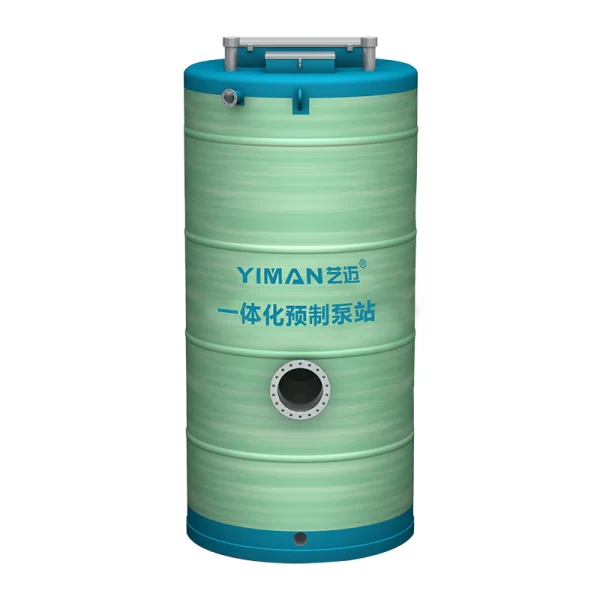
- Packaged Systems: Pre-engineered units, like our Sewage Water Elevating System, combine tank, pumps, controls, and piping for streamlined installation.
2. Ensuring Proper Ventilation and Odor Control
Safety and community acceptance hinge on gas management.
- Ventilation Systems: Use forced ventilation to exhaust hydrogen sulfide, methane, and maintain safe oxygen levels.
- Odor Control Technologies: Where sensitive, deploy activated carbon, biofilters, or chemical scrubbers.
- Tank Sealing: Keep tanks tight, venting only through controlled points.
- Retention Time Management: Control cycle timing to limit odor-forming conditions.
3. Implementing Effective Monitoring and Alarm Systems
Modern monitoring prevents small issues from becoming big ones.
- Level Sensors: Employ reliable devices—ultrasonic, pressure transducers, or multiple floats—for continuous level tracking.
- Pump Status Monitoring: Track run time, current draw, and faults to spot trends early.
- Alarm Systems: Configure alerts for high level, pump failure, power loss, and comms faults; notify via SMS, email, or SCADA.
- SCADA Integration: Centralize oversight and logging for larger or complex networks.
- Remote Access: Enable secure remote visibility and control for rapid response.
4. Regular Maintenance Practices to Extend System Lifespan
Proactive maintenance pays for itself many times over.
- Routine Inspections: Check tank, pumps, controls, and piping for wear, corrosion, and leaks.
- Pump Maintenance: Follow OEM guidance—impeller clearances, lubrication, electrical checks—and periodically remove and clean Submersible Sewage Pump to clear buildup.
- Float Switch Calibration: Verify set points and operation to maintain correct cycling.
- Tank Cleaning: Remove settled solids and grit on a schedule to prevent blockages and odors.
- Control Panel Checks: Inspect wiring, relays, and test alarms regularly.
- Emergency Preparedness: Maintain and rehearse plans for outages, pump failures, and overflow scenarios.
If you are interested in optimizing your sewage elevating system for peak performance, we recommend reading Optimizing Your Sewage Elevating System for Peak Performance.
Shanghai Yimai Industrial Co., Ltd.’s Advanced Sewage Water Elevating Systems
At Shanghai Yimai Industrial Co., Ltd., we specialize in providing advanced and reliable solutions for wastewater management. Our Sewage Water Elevating System are engineered to meet the stringent demands of modern infrastructure.
1. Features and Benefits of Our Integrated Solutions
Our Sewage Water Elevating Systems are designed with a focus on efficiency, reliability, and ease of maintenance. We offer tailored solutions for diverse applications, from residential buildings to large-scale municipal projects.
| Feature | Benefit |
|---|---|
| Integrated Compact Design | Minimizes footprint, simplifies installation, reduces civil works. |
| High-Efficiency Pumps | Reduces energy consumption, lowers operational costs. |
| Intelligent Control System | Automated operation, remote monitoring, fault detection, predictive maintenance. |
| Robust Construction | Durable materials ensure long lifespan, corrosion resistance. |
| Solids Handling Capability | Prevents clogging, reduces maintenance frequency. |
| Alarm and Monitoring | Real-time alerts, prevents overflows, ensures continuous operation. |
| Customizable Capacity | Tailored to specific inflow rates and site requirements. |
Our systems are particularly suitable for locations where gravity drainage is not feasible, such as subway stations, underground shopping malls, and parking lots. We ensure that every component, from the tank to the pumps and controls, works synergistically for optimal performance.
2. How Our Systems Support Correct Sizing and Performance
We design our Sewage Water Elevating System to integrate seamlessly with precise sizing calculations, ensuring maximum efficiency and reliability.
- Modular Design: Available models (YMWM, YMWP, YMWB) offer Max Flow Rates up to 130 m³/h and Max Head up to 60 m, enabling precise alignment with calculated inflows and TDH.
- Advanced Control Logic: Intelligent panels modulate cycling to avoid short-cycling and long retention, protecting pumps and minimizing septicity.
- Integrated Sensors: Built-in level sensors and flow meters validate design assumptions and support fine-tuning.
- Solids Management: Tank internals and pump selections (e.g., robust impellers) maintain solids movement and reduce manual cleaning.
- Compliance and Safety: Engineered to meet international safety and environmental standards, including ventilation and alarm provisions.
- Expert Support: Our engineers assist with sizing, selection, and installation to match each project’s requirements precisely.
We are committed to delivering solutions that not only meet but exceed performance expectations. Our focus on precision engineering and intelligent design ensures that your wastewater management infrastructure is both efficient and sustainable.
Partner with Shanghai Yimai Industrial Co., Ltd. for Optimal Wastewater Solutions
Achieving optimal performance in sewage lifting systems starts with precise sizing and reliable equipment. At Shanghai Yimai Industrial Co., Ltd., we offer advanced Sewage Water Elevating System and expert guidance to ensure your project’s success. Contact us today to discuss your specific requirements and learn how our integrated solutions can enhance your wastewater management infrastructure.
Email: tony@yimaipump.com
Phone/WhatsApp: +86 134 8229 5009
About the Author
As an After-Sales Engineer at Shanghai Yimai Industrial Co., Ltd., I specialize in the technical aspects of our diverse product range, including water pumps, booster systems, and wastewater treatment solutions. My role involves providing expert support, troubleshooting, and ensuring optimal performance and longevity for our clients’ installations. I leverage deep product knowledge and practical experience to deliver reliable, efficient, and sustainable engineering solutions.
FAQs
1. What is the primary purpose of a sewage lifting tank?
The primary purpose of a sewage lifting tank is to collect wastewater from areas where gravity flow is not possible and then pump it to a higher elevation or a main sewer line. It serves as a buffer that lets pumps run intermittently and efficiently, avoiding continuous operation and undue wear.
2. How often should a sewage lifting tank be inspected or maintained?
Quarterly inspections and annual comprehensive maintenance are recommended. This includes verifying pump performance, recalibrating float switches, cleaning out settled solids, and checking electrical components. Staying ahead on maintenance prevents failures and extends system life.
3. What are the signs of an improperly sized sewage lifting tank?
Frequent cycling and premature pump issues point to undersizing; long, infrequent cycles with odors and heavy solids buildup suggest oversizing. Other red flags include peak-period overflows, elevated energy bills from inefficient operation, and corrosion of internal parts.
4. Can an existing sewage lifting tank be upgraded if it’s undersized?
Yes. Potential upgrades include higher-capacity or more efficient pumps, adding a second pump for redundancy, and adjusting float levels to increase effective working volume. In some cases, replacing the tank with a larger unit is the practical solution.
5. What role does pump selection play in tank sizing?
Pump selection is inseparable from sizing. Flow and head characteristics determine working volume and cycle frequency. A well-matched pump efficiently transfers wastewater, prevents short-cycling, and handles solids reliably—key to long-term system performance.