
How Press Machines Dewater Organic Waste: A Comprehensive Guide
Managing organic waste well cuts costs and lightens the environmental load. In practice, we’ve seen how effective dewatering shrinks volume and makes the rest of the process run smoother. To get consistent results, it helps to understand how dewatering press machines actually work. Here we look at the principles, operation, and benefits that turn organic waste into manageable resources.
Understanding Organic Waste and the Need for Dewatering
Organic waste covers food scraps, agricultural residues, and some industrial byproducts, and it brings real disposal challenges. The high moisture content adds weight and bulk, which drives up transport and processing costs. Reducing both before any downstream treatment makes the whole system more workable.
What is Organic Waste and Its Challenges?
Organic waste consists of biodegradable materials originating from plants or animals. Common sources include kitchen waste from households and the catering industry, agricultural waste, and certain municipal solid wastes. The primary challenge lies in its high water content, which can exceed 80%. This moisture makes handling difficult, promotes rapid decomposition, and generates leachate, posing environmental risks. Additionally, the sheer volume of wet organic waste strains landfill capacity and increases logistical expenses.
Why Dewater Organic Waste Reducing Volume and Costs
Dewatering organic waste serves as a practical pre-treatment with several benefits. By removing excess water, we significantly reduce the overall volume and weight of the waste. That reduction directly lowers transportation costs and eases demands on subsequent processing technologies, such as composting or anaerobic digestion. For example, a 50% reduction in volume can halve transport frequency. Higher dry matter also boosts the efficiency of downstream processes, leading to greater energy recovery or better compost quality.
The Science Behind Press Machine Dewatering
Press machine dewatering applies basic mechanics to separate liquid from solid components in organic waste. Pressure compacts the material and drives interstitial water through a permeable medium.
Mechanical Principles of Solid-Liquid Separation
At the core is pressure filtration. Applied force pushes the liquid phase, which can carry dissolved solids and fines, through a filter screen or mesh. Larger solids remain behind, forming a dewatered cake. The behavior follows Darcy’s Law for flow through porous media and the mechanics of compression. Performance hinges on applied pressure, waste compressibility, and the characteristics of the filter media. 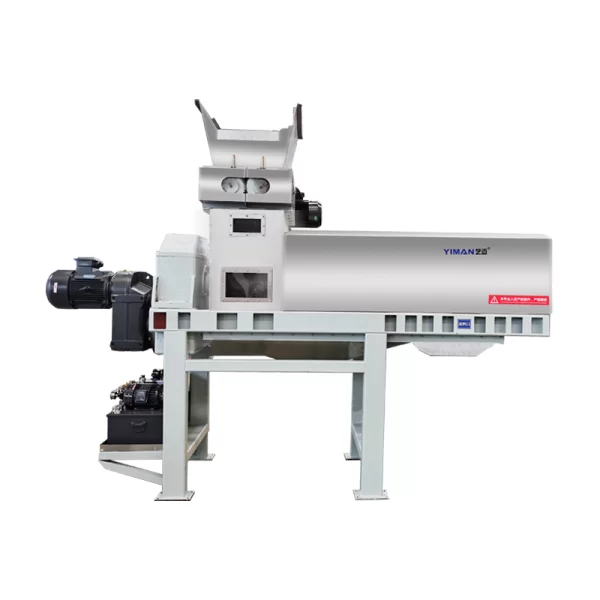
How Press Machines Dewater Organic Waste Step-by-Step
Press-based dewatering runs through a clear sequence, from preparation to final discharge. Working this way supports efficient, repeatable solid-liquid separation.
Pre-Treatment and Feeding Mechanisms
Upfront conditioning helps the equipment do its best work. Shredding or grinding reduces particle size and improves homogeneity. For example, our Double Shaft Shredder Machine processes varied waste streams into smaller, uniform particles. The prepared material is then delivered to the press by an automatic loading and weighing system to keep input continuous and controlled.
The Pressing and Filtration Stages
Inside the machine, material enters the pressing chamber. A double helix continuous press mechanism, for example, ramps pressure gradually. The helical screws move material forward while compressing it. Compression drives liquid through a perforated screen or filter cloth, separating it from the solids. Screw geometry and screen aperture sizing are central to maximizing liquid extraction while keeping solid loss low.
Output and Further Processing of Dewatered Solids
The dewatered solids exit as a compacted cake. Moisture content is significantly reduced, often achieving a decrement rate of 50% or more depending on the material. The separated liquid, or filtrate, is collected for treatment or disposal. The solids are ready for composting, anaerobic digestion, or incineration, which makes downstream operations more efficient. For example, our Intelligent Waste Food Treatment System can further process these solids.
Benefits and Applications in Organic Waste Management
Using press machines for organic waste brings clear environmental and economic gains across many settings. The approach lifts overall efficiency and supports more sustainable operations.
The standout benefit is sharp cuts in volume and weight, which lower transport costs and reduce reliance on landfill. Fewer hauls also mean fewer greenhouse gas emissions from trucking. Dewatering makes downstream processing more effective, whether the goal is energy recovery via anaerobic digestion or producing nutrient-rich compost. Our Organic Waste Treatment System reflects this integrated approach.
Use cases span catering and public facilities such as shopping malls and hospitals, where dewatering food waste trims disposal volumes and prepares material for composting. Food processors see reduced wastewater treatment loads and opportunities for byproduct recovery. Farms can dewater manure, turning it into a more manageable fertilizer or biogas feedstock. The method supports circular economy goals by turning waste into resources.
Choosing the Right Press Machine for Your Needs
Choosing a dewatering press starts with matching the machine to the waste stream to get performance and costs in balance. The type and characteristics of the organic waste carry the most weight.
Assess composition, moisture content, and particle size. Food waste, sludge, and agricultural residues can call for different press designs and filter media. Our Double Helix Continuous Presser is built for a range of organic materials and achieves a 50% decrement rate. Define the treatment capacity (Kg/h) and the target decrement rate, since these dictate machine size and power. Factor in moisture content as well. For example, our double helix continuous presser is optimized for materials with 50% moisture content. Review operational efficiency, maintenance needs, and energy consumption. Intelligent automatic operation and remote monitoring can lower labor costs and raise reliability.
FAQs
What types of organic waste can be dewatered by press machines?
Press machines handle a wide range of organic wastes. Examples include food waste from commercial kitchens, restaurants, and households, plus agricultural residues like fruit and vegetable pulp, manure, and spent grains. They also work for sludge from wastewater treatment and other biodegradable industrial byproducts. Screw configuration and filter mesh can be tuned to match the characteristics of each waste stream.
How does dewatering improve the efficiency of subsequent waste treatment?
Lowering moisture boosts the performance of downstream treatment. In composting, less water speeds decomposition and improves product quality. In anaerobic digestion, higher dry matter raises biogas yield and produces a more concentrated digestate. For incineration, dewatered waste carries a higher calorific value, so combustion is more efficient and needs less auxiliary energy. This pre-treatment helps recover more value and holds overall processing costs down.
What are the key advantages of screw press machines for organic waste?
Screw presses bring clear advantages for organic waste. They separate solids from liquids efficiently and can deliver significant volume reduction. Continuous operation supports high throughput and automation, which cuts labor needs. The enclosed layout limits odor and splash, improving workplace hygiene. They are also robust, need relatively low maintenance, and handle a wide range of consistencies, so they suit many organic waste streams.
How often do press machines require maintenance?
Maintenance frequency depends on the waste handled, hours of operation, and machine design. Plan routine tasks such as cleaning and inspecting wear parts like screws and filter screens on a weekly or bi-weekly cycle. Broader tasks, including lubrication and replacement of worn components, can be scheduled monthly or quarterly. An annual overhaul helps sustain reliability and performance over the long term. Following the manufacturer’s guidelines helps extend service life.
Optimize Your Waste Management with Yimai Industrial
See how Shanghai Yimai Industrial’s dewatering solutions can optimize your organic waste management. We offer robust, efficient systems built for diverse industrial needs. Contact us for a consultation and learn how our expertise can support your operations.
Email: overseas1@yimaipump.com
Phone/WhatsApp: +86 13482295009