Intelligent Modular Water Plants: Sustainable Urban-Rural Solutions
Water infrastructure decisions rarely come with simple answers. Every site brings its own constraints—budget limits, timeline pressures, regulatory requirements, and the physical realities of terrain and existing systems. Intelligent modular water plants have emerged as a practical response to these challenges, combining treatment technology with automation in configurations that can be deployed faster and adapted more readily than conventional approaches. The appeal lies not in any single feature but in how the pieces work together: standardized modules that reduce engineering time, smart controls that minimize operator intervention, and compact footprints that fit where traditional plants cannot.
Why Conventional Infrastructure Struggles with Modern Water Demands
Global water scarcity and quality degradation continue to intensify, yet the tools available to address them have not always kept pace. Traditional water infrastructure projects demand substantial capital, extend over months or years, and lock communities into fixed capacities that may not match future needs. These limitations hit hardest in areas where flexibility matters most—rapidly growing urban peripheries, remote communities without existing networks, and regions where climate variability makes demand unpredictable.
Rapid deployment water plants address these gaps directly. They offer water scarcity solutions that can reach remote water access points without the extended timelines of conventional construction. Urbanization challenges compound the problem; cities expanding faster than their infrastructure can absorb need treatment capacity that scales with population growth rather than lagging behind it. Rural development faces the opposite constraint—populations too dispersed to justify centralized systems but still requiring reliable supply. Water treatment innovation in modular form bridges both scenarios.
The practical reality is that strained municipal systems and underserved villages share a common need: treatment capacity that arrives when required, performs reliably, and does not demand resources the community cannot sustain.
Achieving Efficient Water Supply Through Modular Design
Intelligent modular water plants combine prefabricated construction with automated operation to compress both deployment schedules and operating budgets. Where conventional projects require extensive site preparation and custom engineering, modular systems arrive substantially complete from manufacturing facilities. On-site work focuses on assembly and commissioning rather than ground-up construction.
This approach delivers operational expenditure reduction through multiple channels. Energy consumption drops when pumps and controls are optimized as integrated systems rather than assembled from mismatched components. Automated processes reduce labor requirements without sacrificing oversight. The result is a reliable water supply that reaches communities faster and costs less to maintain over its operating life.
Components That Make Modular Treatment Work
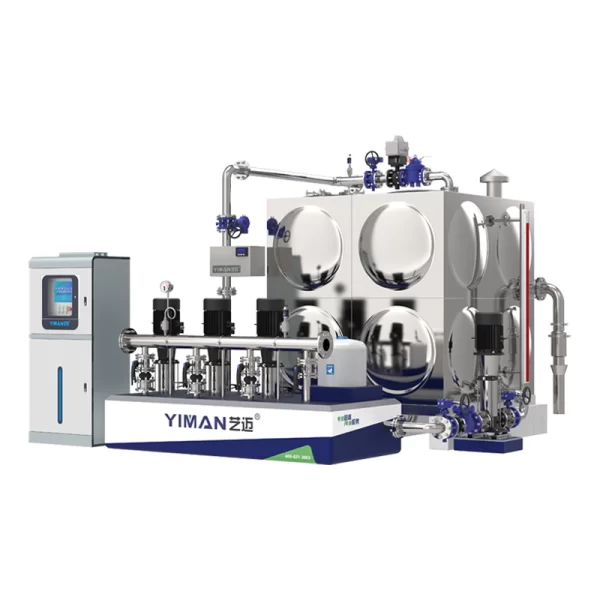
A modular intelligent water plant integrates several functional elements into a coordinated system. Advanced filtration stages remove suspended solids and contaminants according to source water characteristics. Smart sensors track turbidity, pH, chlorine residual, and other parameters continuously, feeding data to control systems that adjust treatment in real time.
SCADA water systems provide the supervisory layer, enabling operators to monitor performance remotely and respond to alerts without maintaining constant on-site presence. Energy-efficient pumps—including vertical multi-stage centrifugal designs and intelligent digital driven VFD booster systems from manufacturers like Shanghai Yimai—reduce power consumption while maintaining required pressures and flows. These components function as smart water systems because they communicate, adapt, and optimize collectively rather than operating in isolation.
| Feature | Modular Intelligent Water Plant | Traditional Water Treatment Plant |
|---|---|---|
| Deployment Speed | Days to Weeks | Months to Years |
| Scalability | Highly Scalable | Limited |
| Footprint | Compact | Large |
| Cost-Effectiveness | Optimized CAPEX/OPEX | High CAPEX/OPEX |
| Flexibility | High | Low |
Meeting Quality Standards Through Continuous Monitoring
Water quality monitoring determines whether treatment systems protect public health or merely move water from one place to another. Intelligent modular water plants build monitoring into their operational architecture rather than treating it as an add-on function. Sensors positioned throughout the treatment train detect deviations before they affect finished water quality.
This matters particularly for potable water production in areas without established testing infrastructure. Water quality issues in remote areas often go undetected until illness occurs; continuous monitoring changes that equation. Remote monitoring capabilities allow qualified personnel to oversee multiple sites simultaneously, responding to anomalies in real time regardless of physical distance.
Regulatory compliance water standards vary by jurisdiction but share common requirements for documentation and consistency. Automated data logging satisfies record-keeping obligations while providing the evidence base for public health water safety assurance. Communities gain confidence not from promises but from verifiable performance data.
Decentralized Networks as an Alternative to Centralized Systems
Decentralized water treatment distributes treatment capacity across multiple points rather than concentrating it in single large facilities. This configuration offers resilience advantages—a failure at one node does not compromise the entire network. Distribution losses, which can exceed 30% in aging centralized systems, drop substantially when treatment occurs closer to end users.
The approach adapts to demand patterns that centralized systems handle poorly. Urban areas with uneven development can add capacity incrementally as neighborhoods grow. Rural regions can serve scattered populations without the expense of extensive transmission infrastructure. Community water supply systems gain independence from distant treatment facilities and the vulnerabilities of long distribution lines.
Water security strategies increasingly recognize that redundancy matters. Distributed networks provide that redundancy inherently, maintaining service even when individual components require maintenance or face unexpected challenges.
Connecting Modular Plants to Existing Systems
Intelligent modular water plants do not require greenfield sites or complete infrastructure replacement. They integrate with existing water networks as supplemental treatment capacity, pressure boosting stations, or emergency backup systems. A municipality with adequate treatment but insufficient distribution pressure can add modular booster stations without rebuilding its plant. A system facing seasonal demand spikes can deploy temporary modular capacity during peak periods.
Smart city water integration extends this flexibility to urban environments where space constraints and existing infrastructure limit options. Modular units fit into locations where conventional plants cannot, providing localized treatment that reduces transmission distances and associated losses.
Lifecycle cost analysis water infrastructure reveals that adaptability carries financial value. Systems that can be reconfigured, relocated, or expanded protect investments against changing conditions that would strand less flexible assets.
Financial and Environmental Performance of Modular Approaches
The economic case for intelligent modular water plants rests on both initial and ongoing costs. Capital expenditure optimization comes from factory production efficiencies, reduced site work, and shorter project timelines that minimize financing costs. Operational expenditure reduction follows from energy efficiency, automation, and designs that simplify maintenance.
Environmental performance tracks similar patterns. Compact footprints disturb less land. Energy-efficient operation reduces carbon footprint compared to older treatment technologies. Modular designs facilitate wastewater reuse by enabling treatment configurations matched to specific reuse applications rather than one-size-fits-all approaches.
The return on investment emerges from efficiency gains sustained over operating lifetimes measured in decades. Plants that cost less to build, less to run, and less to maintain deliver value that compounds with each year of operation.
Frequently Asked Questions About Modular Water Plants
How does a modular water plant address water quality issues in remote areas?
Remote locations present treatment challenges that modular systems address through self-contained design and remote oversight capabilities. Advanced filtration and disinfection technologies handle variable source water quality without requiring specialized local expertise. Real-time monitoring detects treatment upsets immediately, while remote control allows qualified operators to adjust processes from any location with network connectivity. The compact, transportable format bypasses the need for extensive distribution infrastructure that would be impractical to build and maintain in isolated settings.
What are the long-term operational costs associated with intelligent modular water plants?
Long-term costs depend on site conditions and utilization patterns, but modular systems typically achieve lower lifecycle expenses than conventional alternatives. Energy-efficient components reduce utility bills throughout the operating life. Automated processes minimize labor requirements without sacrificing treatment quality. Predictive maintenance capabilities—enabled by continuous monitoring—catch developing problems before they cause failures or require emergency repairs. Modular Integrated Water Plant solutions optimize initial capital while these operational efficiencies compound over time.
Can intelligent modular water plants integrate with existing water infrastructure?
Integration flexibility is a core design principle. Modular plants connect to existing distribution networks as supplemental treatment capacity, pressure management stations, or emergency reserves. They can operate independently or as coordinated elements within larger systems. Scalability allows capacity additions or reductions as demands change, protecting investments against the uncertainty that makes long-term infrastructure planning difficult. Both urban systems seeking to extend coverage and rural networks requiring localized treatment find configurations that match their specific requirements.
Partner with Shanghai Yimai Industrial Co., Ltd. for Advanced Water Solutions
Discover how Shanghai Yimai Industrial Co., Ltd.’s intelligent modular water plant solutions can transform your urban and rural water infrastructure. Partner with us for sustainable, efficient, and reliable water management. Contact our experts today at overseas1@yimaipump.com or +86 13482295009 for a tailored consultation and to explore our comprehensive range of water treatment technologies.